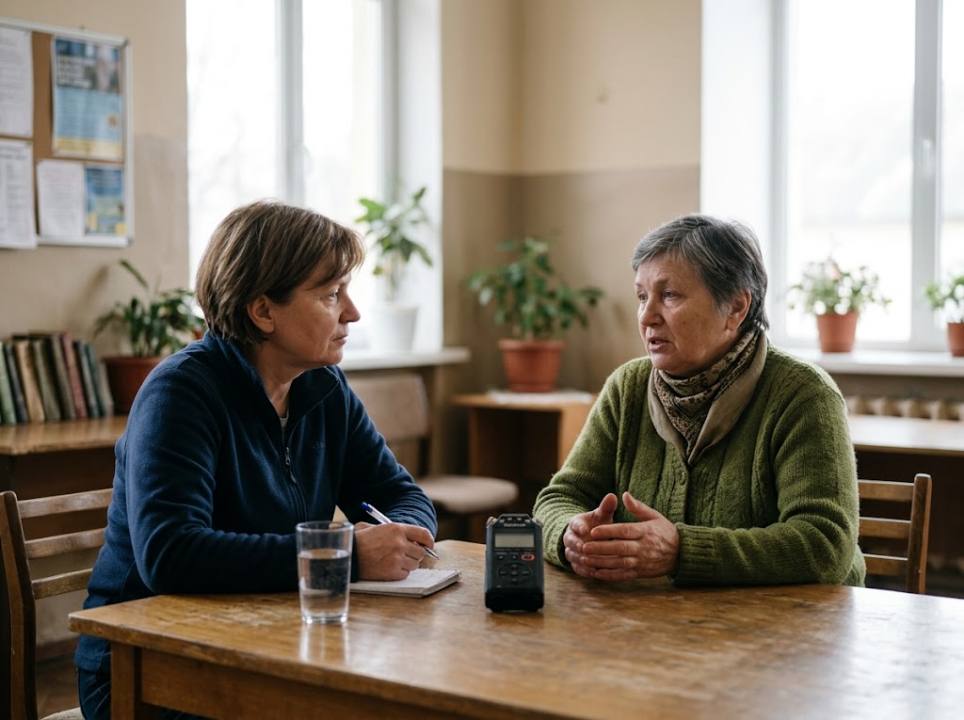
A growing amount of Ukrainian-language content exists in audio and video form: interviews with journalists and researchers, podcasts, witness testimonies, humanitarian needs assessments, corporate meetings and court recordings. Before this content can be analysed, published or used as evidence in English-speaking contexts, it must be transcribed and translated accurately.
This guide explains how professional Ukrainian audio transcription and translation works and what to consider when planning a project.
Step One, Accurate Transcription
Everything starts with a transcript in the original language. A native Ukrainian transcriber listens to the recording and writes down exactly what is said. Depending on the purpose, the transcript may be verbatim, including hesitations and false starts, or clean, focusing on meaning. Research and legal projects usually require verbatim transcripts, while media and business projects prefer clean ones.
Timestamps, speaker labels and notes on inaudible passages are standard features of a professional transcript.
Ukrainian, Russian and Surzhyk
Spoken language in Ukraine is diverse. Many speakers switch between Ukrainian and Russian, sometimes within a single sentence, and some use surzhyk, a mixed form of both. Regional dialects also vary. A transcriber who only knows standard written Ukrainian may struggle. Choose linguists who are comfortable with real spoken language, not only textbook Ukrainian. Where Russian passages appear, professional English to Russian translation and Russian to English specialists can support the same project.
Step Two, Translation
Once the transcript is finalised, a translator produces the Ukrainian to English translation. For interviews and testimonies, the translation must preserve the speaker's voice, emotion and meaning without adding interpretation. For business meetings, clarity and correct terminology matter most. The translator should flag culturally specific references and idioms that might be misunderstood.
Step Three, Subtitles or Reports
The final format depends on the use case. Media organisations may need English subtitles for video. Researchers may need a bilingual transcript with Ukrainian and English side by side. Legal teams may need a certified translation. Agreeing the output format at the start saves time and avoids rework.
Sensitive Content and Ethics
Many Ukrainian recordings today involve difficult subjects: displacement, loss, war-related experiences. Translators and transcribers working on such material need care, discretion and sometimes emotional support themselves. Confidentiality agreements, secure file handling and respect for the people speaking are essential.
Cultural Context
Understanding Ukrainian culture helps translators render references correctly. Institutions such as the Ukrainian Institute promote Ukrainian culture internationally and offer insight into contemporary Ukrainian society, language and arts.
English to Ukrainian for Outreach
The process also runs in reverse. Humanitarian organisations, schools, health services and employers produce audio and video in English that Ukrainian speakers need to understand. English to Ukrainian translation of scripts, followed by voice-over or subtitles, makes information accessible to refugees and communities abroad.
Managing Large Projects
Research programmes and media archives can involve hundreds of hours of recordings. Coordinating transcribers, translators and reviewers across such volumes requires structure. A translation management system helps track each file, apply consistent terminology and keep sensitive material secure.
Glossaries for Recurring Topics
Projects that focus on one theme, such as humanitarian aid, energy infrastructure or healthcare, repeat the same names, organisations and technical terms across many recordings. Building a glossary early, with approved English equivalents for Ukrainian place names, institutions and programme titles, keeps translations consistent across dozens of transcripts. It also speeds up the work of every new translator who joins the project.
Review and Quality Assurance
For important material, a second linguist should review the translation against the audio, not only against the transcript. This catches mishearings, missing passages and subtle shifts in tone. For evidence or publication, a final spot check by a senior reviewer adds another layer of confidence. The extra time is small compared with the cost of correcting an error after a report or documentary has been released.
Audio Quality Matters
Poor recordings slow everything down. Background noise, overlapping speakers and distant microphones increase transcription time and the number of inaudible passages. If you are still recording, use good microphones, quiet rooms and one speaker at a time where possible.
Data Protection
Recordings often contain personal data, including names, locations and health information. Make sure your provider complies with data protection rules, stores files securely and deletes them when the project ends, unless you ask otherwise.
Costs and Turnaround
Transcription is usually priced per audio minute, translation per word or per minute of source audio. Difficult audio, multiple speakers and verbatim requirements increase cost. Plan realistic timelines, especially for large volumes.
Choosing a Provider
Look for native Ukrainian linguists experienced with spoken language, clear confidentiality procedures and flexible output formats. Professional Ukrainian translation services from PoliLingua cover transcription, translation and certified work in both directions.
The Takeaway
Every recording carries a human voice. Careful transcription, faithful translation and respect for the speaker ensure that voice is heard accurately in English.