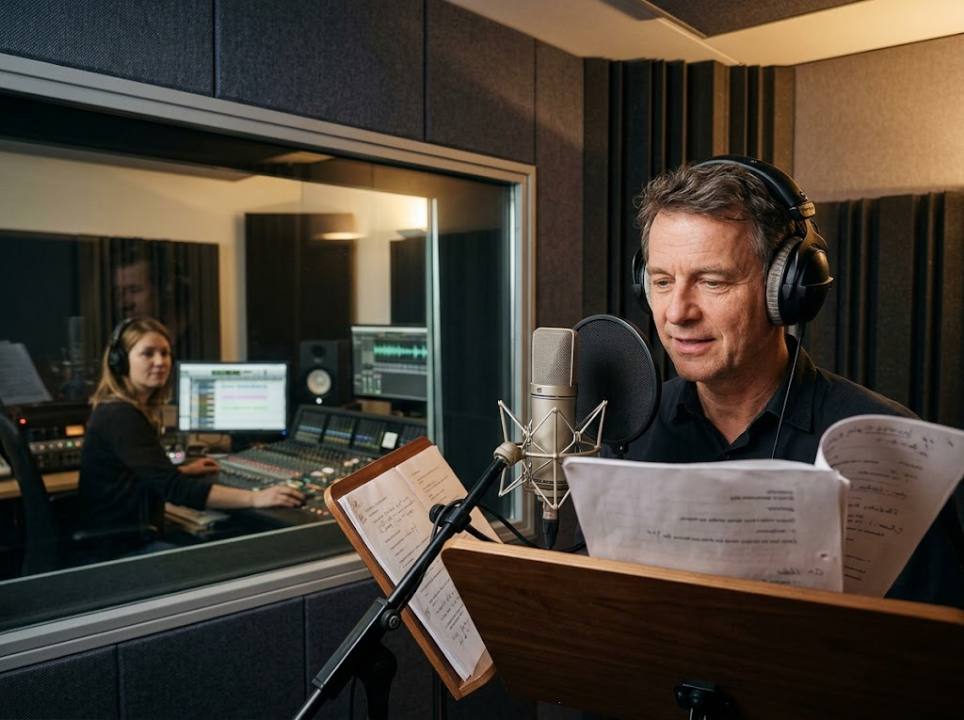
Audio content is booming. Companies produce podcasts, e-learning courses, explainer videos, radio ads, phone menus and product tutorials, and many of them want German versions for Germany, Austria and Switzerland. Others receive German audio and video that must be transcribed and translated into English. Translating for the ear is different from translating for the page, and it pays to understand why before starting a project.
Writing for Speech
Text meant to be spoken needs short sentences, natural rhythm and words that are easy to pronounce. German written style, with long compound nouns and nested clauses, can sound heavy when read aloud. A good translator adapts the script so that a voice actor can deliver it smoothly, while keeping the meaning of the original.
Timing Is Everything
German typically runs longer than English, often by 20 to 30 percent in spoken form. In a video, the German voice-over must fit the same scenes and cuts as the English original. Translators working on voice-over scripts therefore condense, rephrase and sometimes restructure sentences so they match the available time. For lip-synced dubbing, the constraints are even tighter.
Formal or Informal Address
German distinguishes between the formal "Sie" and the informal "du". Many brands aimed at younger audiences now use "du", while financial, legal and B2B content usually stays with "Sie". The choice affects every sentence of a script and should be agreed before translation starts. Mixing both in one video sounds unprofessional.
Regional Considerations
Standard German works across Germany, Austria and Switzerland, but vocabulary and pronunciation vary. A voice actor from Hamburg sounds different from one from Vienna or Zurich. For national campaigns, some brands choose regionally appropriate voices. For most corporate content, a neutral standard German voice is the safest choice.
Pronunciation Guides
Scripts often contain brand names, product names, acronyms and foreign words. Voice actors need to know how to pronounce each one. A good localization workflow includes a pronunciation guide with phonetic hints, agreed before the recording session. That avoids costly re-recordings later.
German to English for Audio and Video
The reverse direction is common too. Companies receive German interviews, webinars, market research recordings and training videos that need English transcripts and translations. German to English translation services for audio start with an accurate transcript, followed by translation and, if required, subtitles or an English voice-over. Public broadcasters such as Deutsche Welle show how professionally produced multilingual audio and video can reach international audiences.
Legal and Official Recordings
Some recordings are used as evidence in legal proceedings, insurance claims or official investigations. In these cases, the transcript and translation may need certification. Certified German translation services can provide a signed statement of accuracy or a sworn translation, depending on the jurisdiction.
Working With Scripts Efficiently
Scripts for e-learning series or product tutorials often repeat instructions and terms. Translators working in a professional CAT editor reuse approved sentences through translation memory, keeping terminology consistent across dozens of modules and reducing cost for updates.
Multilingual Audio Projects
Many audio projects run in several languages at once. A training library produced in English might need German, French and Russian versions for different regions. Professional Russian translation to English and into Russian can run alongside the German work, with shared glossaries so that terminology stays aligned.
Casting the Right Voice
The voice carries the brand. A warm, conversational voice suits consumer products and wellness content, while a calm, authoritative voice fits financial services or medical training. Share references from your English recordings so the German casting matches the tone. For long e-learning series, book the same voice actor for every module to keep the experience consistent, and plan for pick-up sessions when scripts change after recording.
Subtitles as an Alternative
Not every project needs a voice-over. For internal videos, interviews or social media clips, German subtitles are often faster and cheaper. They also keep the original speaker's voice, which many viewers appreciate. The decision depends on audience, budget and how the content will be consumed, for example on mobile devices with the sound off.
Quality Control for Audio
After recording, a native German reviewer should listen to the final audio, not just read the script. Mispronunciations, wrong emphasis, timing problems and audio glitches are only caught by listening. Build this step into the schedule from the beginning, and allow time for short re-recordings.
Choosing a Partner
Look for translators experienced in scripts and voice-over, access to professional voice talent, and a clear process from translation through recording and review. The German translation services at PoliLingua include script translation, transcription, subtitling support and certified translations for official use.
The Takeaway
Audio in German should sound as natural as it would if it had been written in German. Adapted scripts, clear pronunciation guidance and a final listening check turn a translation into a recording that works.